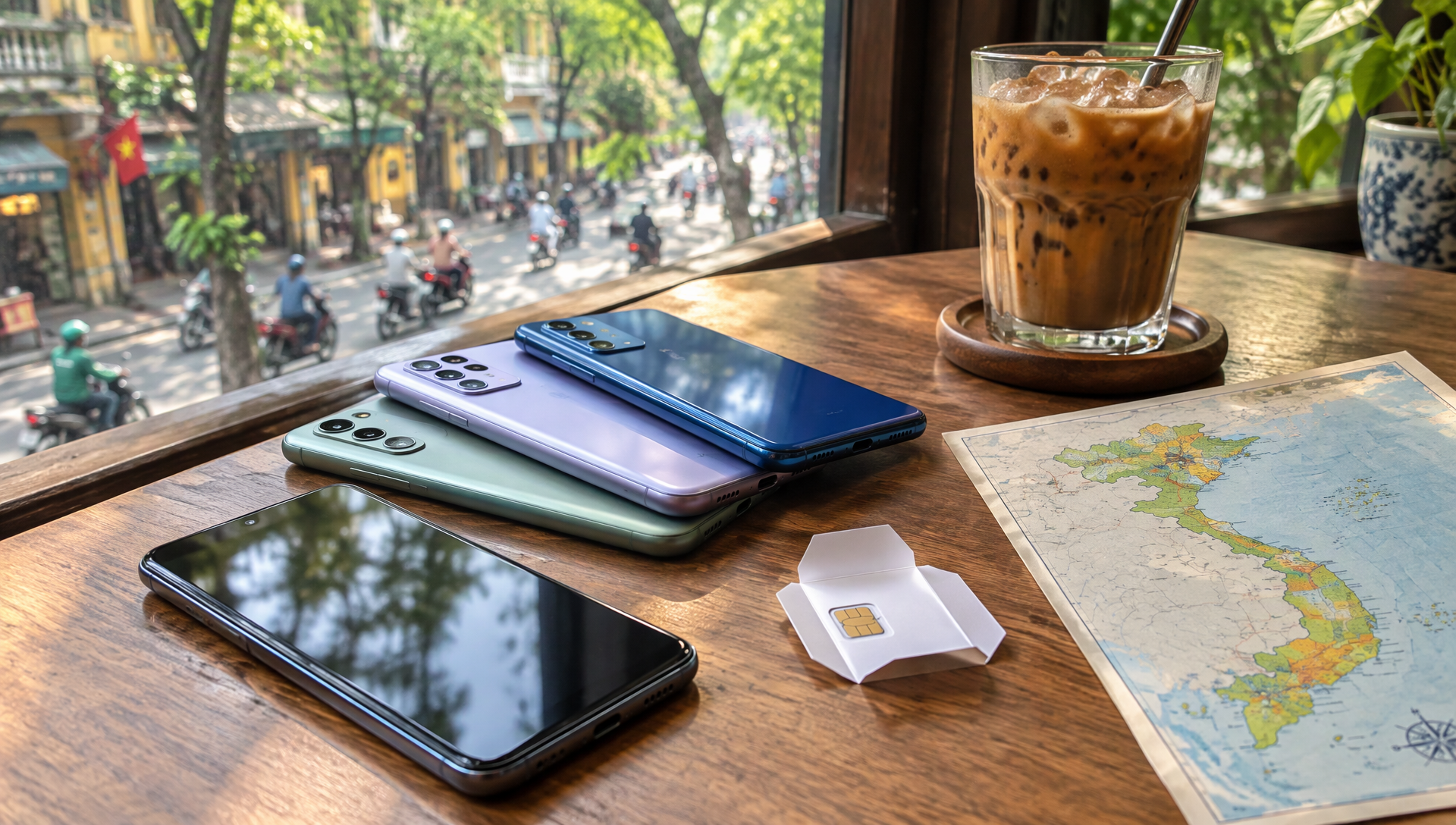
Short answer: If your phone supports eSIM and is not locked to a carrier, buy an eSIM before you fly or as soon as you land. It takes about ten minutes and skips the airport queue. If your phone does not support eSIM, buy a tourist SIM from an official Viettel, Vinaphone or Mobifone shop in a city, not from a stall at the airport, and bring your passport for registration. Either way, check the coverage in the places you plan to visit, because signal can be weaker in remote areas such as the northern mountains and some national parks.
Staying connected in Vietnam matters more than most travelers expect. Maps, ride-hailing apps, bank apps, translation and restaurant bookings all depend on mobile data, and a reliable connection makes getting around far less stressful. The good news is that mobile data is cheap and widely available. The harder part is choosing between the options, because prices and plan names change often and the advice online is not always up to date.
This guide explains the main choices, what they cost in general terms, how to register, and the mistakes travelers make most often.
Travelers in Vietnam usually choose between a physical tourist SIM card, an eSIM bought online, or international roaming from their home carrier. Each has a clear role.
| Option | Best for | Watch out for |
|---|---|---|
| Local tourist SIM | Long stays, lowest cost per gigabyte, and a local phone number | Needs a phone that accepts a physical SIM, registration with your passport, and a visit to a shop |
| eSIM | Short trips, fast setup and keeping your home SIM active | Your phone must be eSIM-compatible and unlocked. Many eSIM plans are data only. |
| Home carrier roaming | Very short stays or a single emergency | Often the most expensive option for regular daily data use |
Vietnam's main mobile networks are Viettel, Vinaphone and Mobifone. All three sell tourist SIM cards with a set amount of data for a fixed period, often one month. Plans with a few gigabytes per day are common, and some include unlimited data at lower speeds after a daily limit. Prices vary by plan and by seller, and they change over time, so check the current offer in the shop before you pay.
As a rough guide, a month-long tourist SIM with generous data costs a small fraction of what most people pay at home. Airport counters usually charge more than official city shops for the same plan, and the queue can be long after a late flight.
Under Vietnamese rules, every SIM must be registered to a real person. For a foreign visitor, that means showing your passport at the shop, and the seller will record your details. Bring the original passport, not a photo of it. Some shops may ask you to sign a form or take a photo of your face, so keep a little patience for the process.
Ask the seller to activate the SIM before you leave the counter. Make a quick call and send a message to confirm the data works. A SIM that fails at the hotel is much harder to fix on the same day.
An eSIM is a digital profile you download to your phone. You can buy it online before you fly, scan a QR code or follow an app setup, and be online as soon as you land. There is no queue and no need to remove your home SIM if your phone supports two active lines.
Before you buy, check three things. First, confirm your phone is eSIM-compatible and not locked to a carrier. Second, check that the plan includes data in Vietnam and the number of days you need. Third, decide whether you need a Vietnamese phone number. Many eSIM plans are data only, which is fine for maps and messages but may not work for some local bank or delivery apps that ask for a local number.
For a broader comparison of plans and how to pick one, the Vietnam SIM card and eSIM guide from CTour walks through the options in more detail.
Quick checklist before you buy
Coverage in cities such as Hanoi, Da Nang and Ho Chi Minh City is strong, and the main towns on the coast and in the Central Highlands also have good signal. Remote areas are different. Parts of the northern mountains, some valleys in the far north and certain national parks can have patchy coverage, and boat trips on the Halong Bay or the Mekong may lose signal for long stretches.
If you are heading into a remote area, download offline maps before you leave the city, save your hotel and tour details in a screenshot, and keep a paper copy of the address in Vietnamese if your driver or guide cannot read English.
Buying from a street vendor. Unofficial SIMs can be unregistered, expired or already used. Buy from an official carrier shop or a reputable online seller.
Choosing the wrong data size. Buying a small plan for a two-week trip with heavy map and video use means running out in the middle of the trip. Estimate your daily use before you buy.
Forgetting to turn off home data roaming. If you keep roaming on after landing, your home carrier may charge far more than the local plan. Switch it off or use airplane mode until your local line is active.
Buying an eSIM that does not match your phone. Check the phone model and the carrier lock before you pay. A refund is not always easy to get.
Assuming the plan works everywhere. Some plans are for specific networks or regions. Read the coverage details before you leave home.
It depends on your phone and your trip. An eSIM is faster and avoids the queue. A physical SIM is often cheaper for longer stays and gives you a local number for all services.
Yes, for a physical SIM you will need your passport for registration at the shop. Bring the original document.
Viettel is often described as having the widest coverage, especially in rural areas, but all three main networks are good in cities. If you are going to remote regions, ask the seller which network is strongest there.
If your phone supports two active lines, you can add a local eSIM or SIM and keep your home line for calls and messages. Check with your home carrier before you travel.
Yes, the airport has carrier counters. They are convenient but often cost more than city shops, and the process can be slower.
Plan your trip
Planning a route that takes you into remote areas or through several cities? Our team can help you plan the connectivity, transport and timing around your itinerary.
Send us your travel dates, the number of travelers and the cities you want to visit. A consultant will reply with options that work.

Best Vietnam Family Tour with Kids – 14 Days / 13 Nights

Vietnam Classic Itinerary: 11 Days & 10 Nights

Danang Beach Break 4 Days | Relaxing Da Nang Beach Holiday Tour



Mui Ne Beach Escape & Coastal Sightseeing – 5 Days 4 Nights

Vietnam Cultural Journey 10 Days from Ho Chi Minh City

10-Day Vietnam Beach Holiday: Central & Southern Coast Resorts & Experiences

Highlights of Vietnam from North to South 12 days