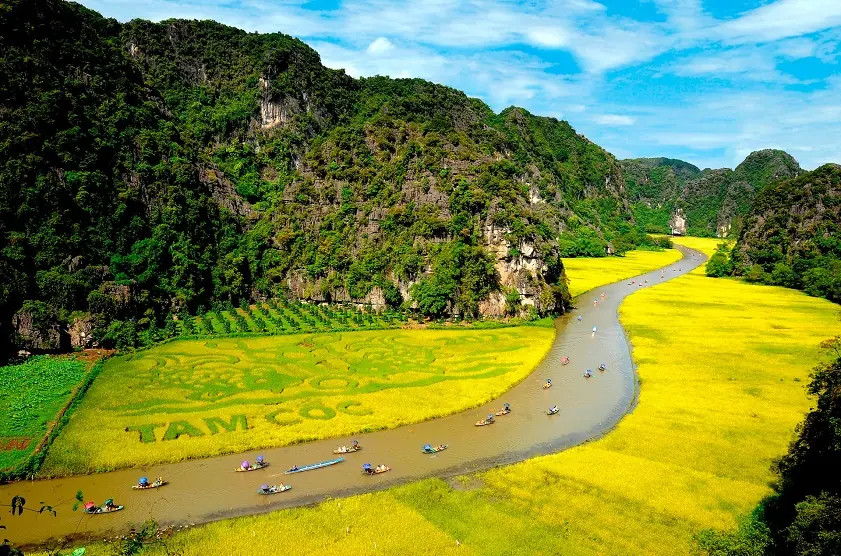
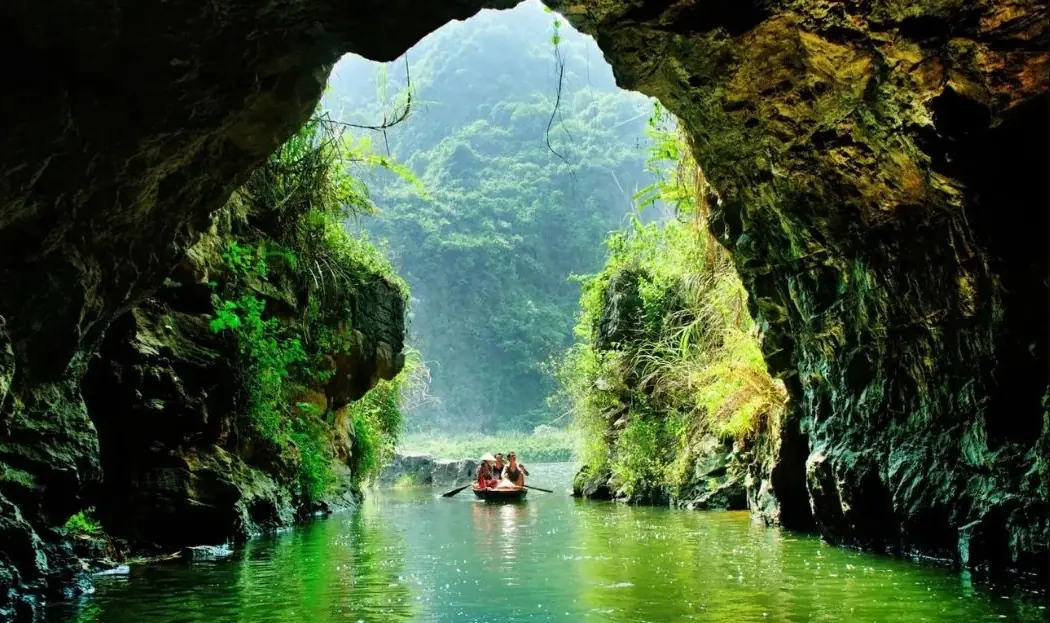
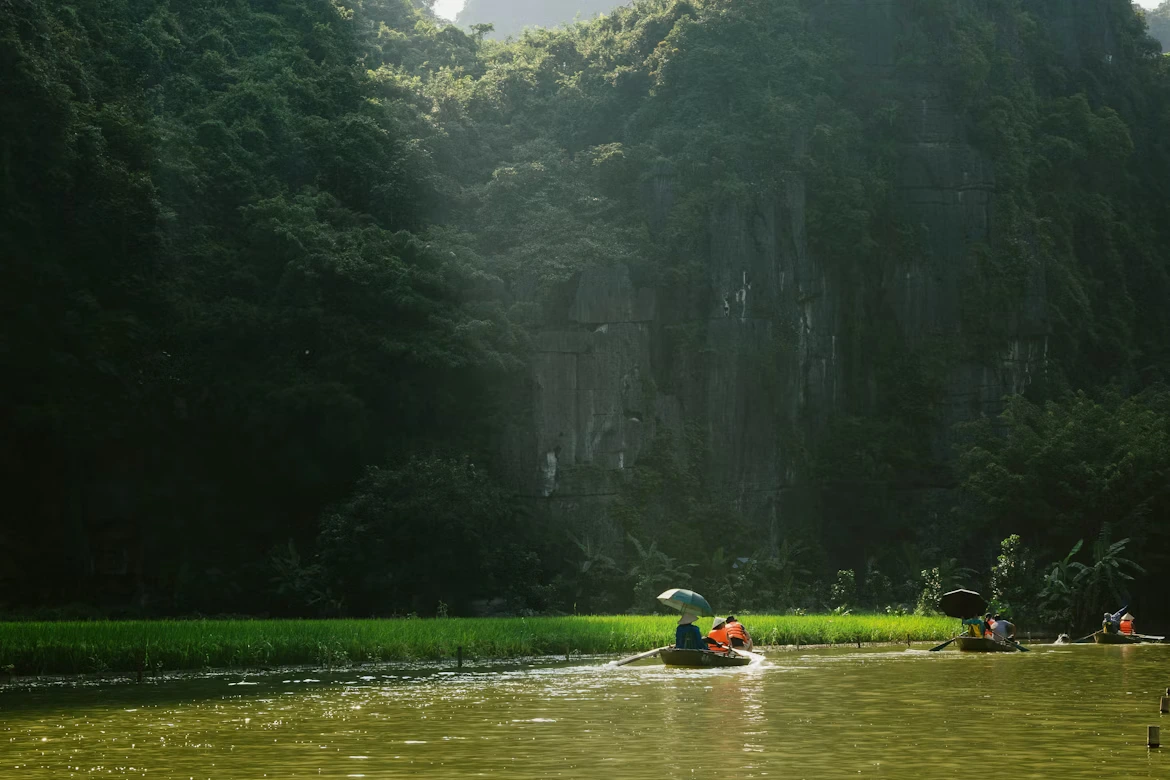
Everyone who does the Tam Coc boat ride sees Ninh Binh at river level — floating through limestone caves, rice paddies on both sides, karst peaks rising above the valley. It is beautiful. But it only shows you half of what this landscape actually is.
Mua Caves (Hang Mua) shows you the other half. From the summit of Ngoa Long Mountain — Lying Dragon Mountain — the same landscape that surrounds you on the boat now spreads below in every direction. The Ngo Dong River winds through gold and green rice fields. Limestone peaks cluster across the plain like a petrified forest. Villages, paddies, waterways: the whole Tam Coc basin laid out in a single frame.
It is one of the best views in Vietnam. The 486 stone steps to reach it are genuinely worth it.
First, a clarification that most visitors only discover on arrival: Mua Caves is not primarily a cave.
There is a small cave at the base of the mountain — modest, atmospheric, worth a look — but it is not the reason people come here. The draw is the hike to the summit and the panoramic viewpoint at the top. Despite the name (Hang Mua translates as "Dance Cave," a reference to royal dance performances held here during the Tran Dynasty in the 13th century), this is a hiking and viewpoint destination above all else.
The site sits inside the Mua Caves Ecolodge complex — a resort property with lotus ponds and decorated gardens that you walk through to reach the mountain trailhead. Some visitors find the resort aesthetic jarring against the natural landscape; others simply walk straight through to the stairs. Either way, the viewpoint itself is unaffected.
Location: 5km north of Tam Coc village center, in Khe Dau Ha village, Hoa Lu district, Ninh Binh Province. About 95km south of Hanoi.
Entrance fee: 100,000 VND (~$4 USD) for adults. Children free. Parking: 5,000 VND bicycle / 10,000 VND motorbike.
Opening hours: 6:00am – 7:00pm daily.
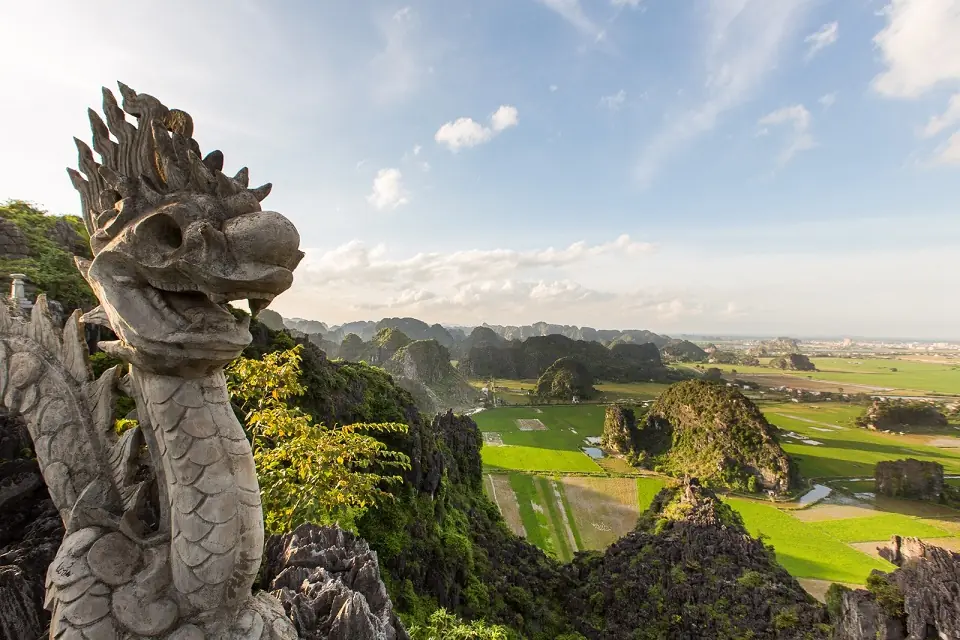
The staircase begins at the base of Ngoa Long Mountain and climbs 486–500 uneven stone steps to the summit at 142 meters above the valley floor. The steps are carved into the limestone and flanked by stone balustrades decorated with intricately sculpted dragons and phoenixes — the climb itself is an aesthetic experience, not just a physical one.
Honest assessment of difficulty: Moderate. Not technical, not dangerous, but steep enough in sections to get your heart rate up. Handrails are available along most of the route. Most reasonably fit adults complete the ascent in 20–30 minutes. Allow more time if you stop for photos — and you will stop for photos.
One important note: The steps can be slippery after rain. Wear shoes with grip. Not flip-flops, not sandals. This is not a metaphor.
Halfway up, the path splits:
Left fork — Dragon Peak: The higher and more popular viewpoint. At the summit, a large dragon sculpture curves dramatically along the ridgeline — described as the tallest dragon statue in Ninh Binh — overlooking the entire Tam Coc valley. A statue of Avalokitesvara Bodhisattva stands nearby under a small shelter with incense and offerings. The view from here is the one on every travel photo of Ninh Binh taken from above.
Right fork — Pagoda Peak: A slightly lower, quieter alternative. Fewer visitors, a different angle on the valley, and a more meditative atmosphere. Worth taking on the way down if you went left first.
Total time on site: Plan 2–3 hours minimum — 30 minutes up, 30–45 minutes at the summit, 20 minutes down, plus time for the base area.
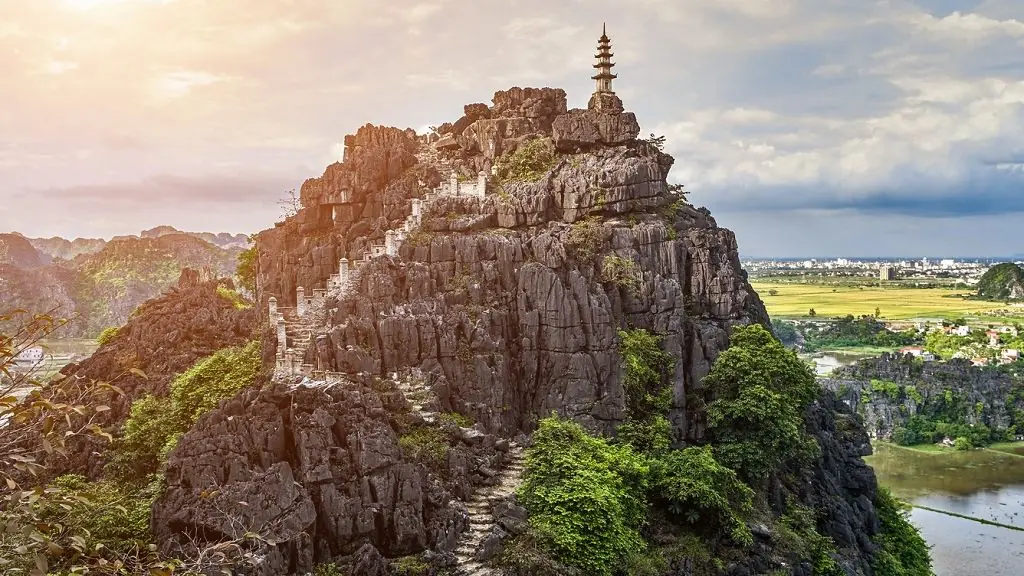
From Dragon Peak at 142 meters, the view is a 360-degree panorama of Ninh Binh's landscape. The Ngo Dong River cuts through rice paddies in long sweeping curves. Limestone karst formations rise from the flat valley floor in every direction — the reason Ninh Binh is consistently called "Halong Bay on Land." Red-roofed village houses punctuate the green and gold of the fields.
What makes this viewpoint particularly powerful is the scale of the perspective. From the boat at Tam Coc, the limestone peaks tower above you. From here, you are level with or above them. The relationship between river, fields, and karsts becomes fully legible — you understand the landscape rather than just being inside it.
The dragon statue at the summit creates the most photographed image in the area: the stone dragon on the ridgeline with the valley dropping away behind it. Morning light hits this from the east; golden hour from the west. Both are worth experiencing.
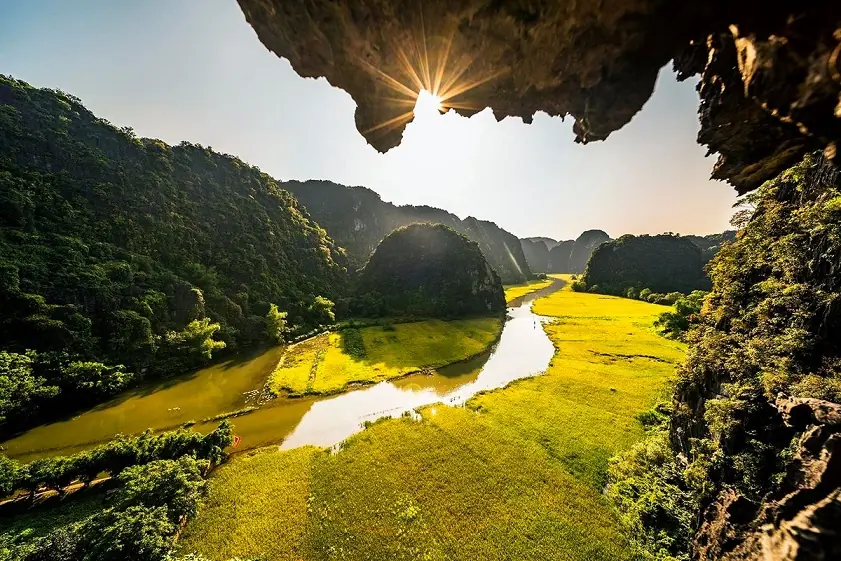
Best season:
Late May to early June is the peak moment — rice paddies at full harvest, turning from deep green to burnished gold before cutting. The contrast between the warm tones of the fields and the grey limestone peaks is the most dramatic the landscape gets. This is when the photographs that define Ninh Binh's visual identity are taken.
November to April (dry season) offers the most reliable weather — clear skies, comfortable temperatures, manageable crowds on weekdays. The rice is green rather than gold but the views are consistently clear.
June to October brings lush greenery and rain. Rain softens the light and adds atmosphere — misty karsts at sunrise can be extraordinary. Steps become slippery and some morning mist obscures the valley entirely. Check forecasts and go early.
Best time of day:
Sunrise (before 6:30am) is the best and the most committed option. The valley fills with soft horizontal light, morning mist threading between the limestone peaks, almost no one else on the stairs. You need to arrive before the gate opens — most guides suggest walking from Tam Coc (30 minutes) or arranging an early motorbike ride.
Late afternoon (4:00–6:00pm) is the second-best window — golden hour light across the rice fields, cooler temperatures than midday, and the crowds beginning to thin.
Avoid 9:00am–2:00pm — peak heat, flat light, maximum crowds.
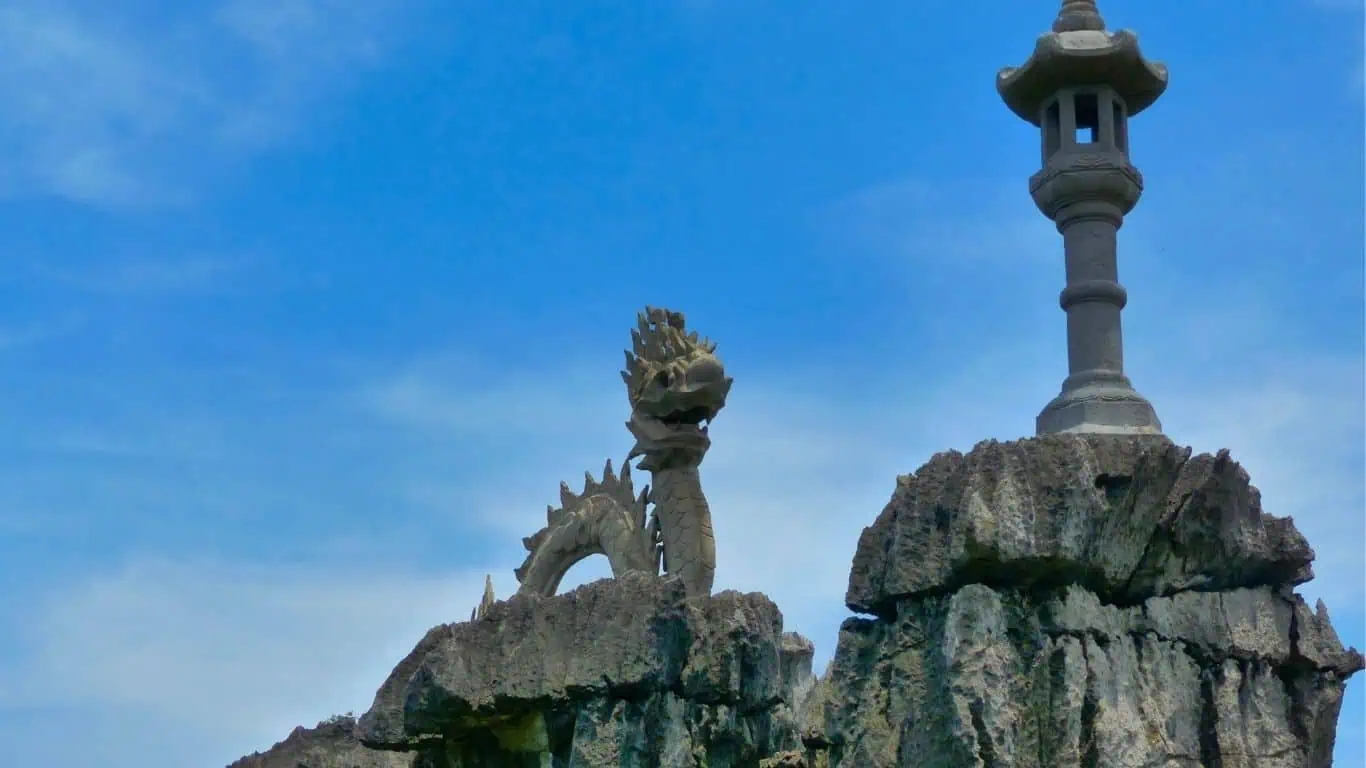
The dragon statue is the primary composition anchor. Stand behind it with the valley as your backdrop — this is the shot. For variety, use the staircase itself with the karsts in the distance as a leading-line composition.
For golden harvest season shots, expose for the rice fields (the mid-tones) and let the sky blow slightly — the warm gold of the paddy against the limestone grey needs no filter.
If mist rolls in below you in the morning, don't leave. Wait 20–30 minutes. The clearing, when the valley re-emerges slowly from white, is often more striking than either the full mist or full clarity.
From Hanoi: About 95–100km south, 2–2.5 hours by car or bus. The most straightforward option for a day trip. Depart by 6:30–7:00am to arrive for the best morning light.
Transport options:
From Tam Coc village center: 5km, about 10–15 minutes by motorbike. Bicycle rental available in the village (~50,000 VND/day) for a more relaxed approach.
C Vietnam Tours offers Ninh Binh day tours from Hanoi that combine Mua Caves with the region's other highlights. Browse Ninh Binh Tours for full-day options with transport and guide included.
Mua Caves works best as part of a full Ninh Binh day — not as a standalone stop. The most logical combinations:
Tam Coc boat tour — River-level limestone cave exploration, 5km from Mua Caves. Do the boat tour first, then climb for the aerial perspective. The two experiences complement each other directly.
Hoa Lu Ancient Capital — Vietnam's 10th-century imperial capital, with two beautifully preserved temple complexes. 15km from Mua Caves, easily combined in a morning.
Bich Dong Pagoda — A three-tiered pagoda built into a limestone cliff, with cave chambers and valley views. 3km from Tam Coc.
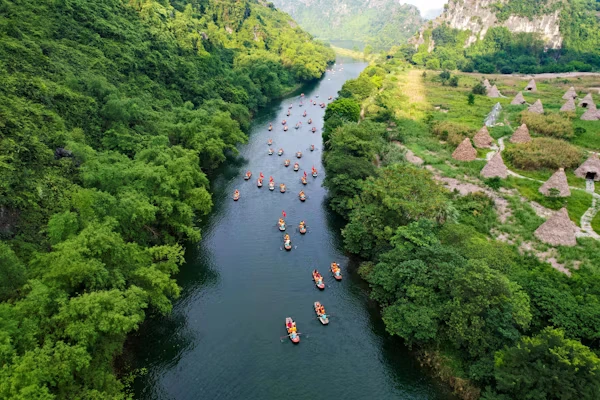
Trang An Scenic Landscape Complex — A UNESCO World Heritage Site of boat-through caves, forested valleys, and ancient temples. The most extensive natural attraction in Ninh Binh and a natural full-day partner. See our complete Ninh Binh Travel Guide for the full picture.
From Ninh Binh, the natural extensions north and south:
| Entrance fee | 100,000 VND adults / children free |
| Opening hours | 6:00am – 7:00pm daily |
| Steps | ~486–500 stone steps |
| Climb time | 20–45 minutes up |
| Total site time | 2–3 hours recommended |
| Best season | Late May–June (golden rice), Nov–April (dry season) |
| Best time of day | Sunrise or late afternoon |
| Distance from Hanoi | ~95km / 2–2.5 hours |
| Distance from Tam Coc | 5km / 10–15 minutes |
Is the Mua Caves hike suitable for children? Active children aged 8 and above generally manage the climb well. The steps are uneven and steep in sections — younger children should be accompanied carefully and wear closed-toe shoes.
Is it worth visiting Mua Caves in the rain? Possible, but with caution. Rain makes the stone steps significantly more slippery. Morning visits are safer as rain tends to come in afternoon bursts. Misty morning conditions after rain can produce spectacular views — the risk is manageable with the right footwear.
Can I visit both Mua Caves and Tam Coc in one day from Hanoi? Yes — this is the standard day tour combination. Boat tour at Tam Coc in the morning, Mua Caves climb in the late morning or early afternoon, back to Hanoi by early evening. Browse Ninh Binh Tours for guided options.
Is there food available at Mua Caves? Light refreshments and drinks are available at the resort complex at the base. For a full meal, Tam Coc village center has numerous restaurants a short ride away.
→ Browse Ninh Binh Tours from Hanoi → Explore Vietnam Highlight Tours → Contact Us to Plan Your Ninh Binh Itinerary
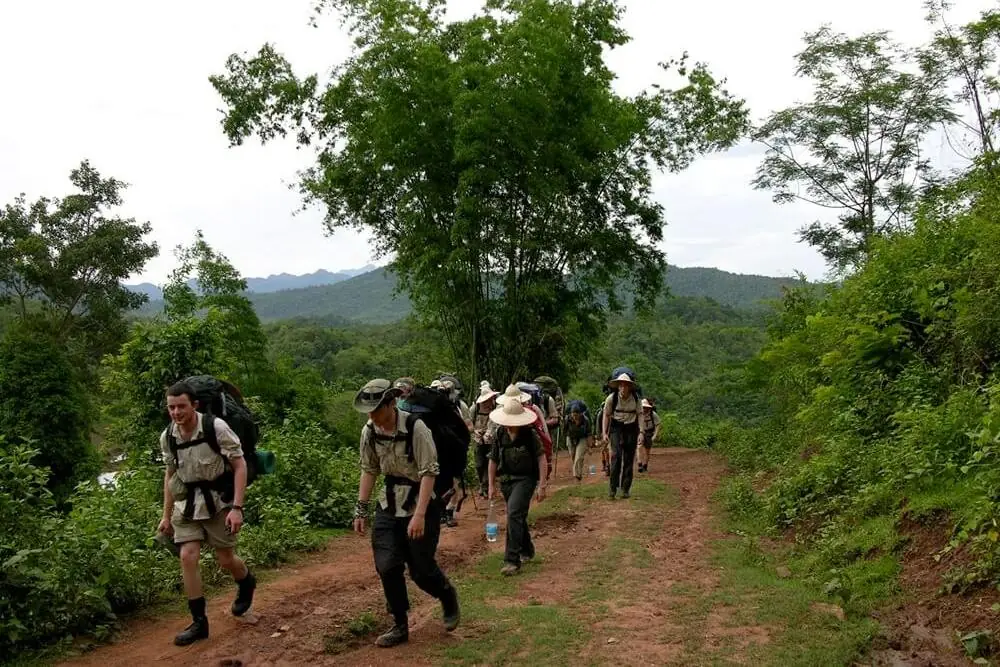
Northern Vietnam Trekking Tour: Mai Chau, Pu Luong & Ninh Binh














 shows you the other half. From the summit of Ngoa Long Mountain — Lying Dragon Mountain — the same landscape that surrounds you on the boat now spreads below in every direction. The Ngo Dong River winds through gold and green rice fields. Limestone peaks cluster across the plain like a petrified forest. Villages, paddies, waterways: the whole Tam Coc basin laid out in a single frame.
It is one of the best views in Vietnam. The 486 stone steps to reach it are genuinely worth it.&)